For B2B founders
Should B2B companies hire someone to build their website, or do it in-house with AI?

WebsitesUpdated 8 min read
Summary
Build it in-house while the website isn’t doing much selling for you. Hire externally once buyers are judging your business by it, because that’s when a page that looks fine but doesn’t make the case starts costing you deals.
- AI has made building a website cheap. Deciding what it should say hasn’t got any cheaper.
- What AI can’t supply is taste, a strategy built on your buyers, evidence of how they use your site, and the judgement to say no.
- Doing it yourself is right while deals are won on calls and referrals and the site rarely comes up.
- Hire someone once you’re moving upmarket, your offer has changed, or buyers research you with AI first.
- Whoever you hire should start with your buyers, show you work before you commit, and leave you able to edit the site yourself.
Contents
- When does building your B2B website in-house make sense?
- When is it worth hiring someone to build your website?
- Why isn’t the build the real cost?
- What can AI do, and what can’t it?
- Why does one homepage prototype take 6–8 hours, even with AI?
- What does a website built this way do?
- What should you look for if you hire externally?
- Is there a middle option?
- How do the three options compare?
- Quick answers
It has never been easier to build a website yourself. With AI tools and modern website builders, a founder can have something live over a weekend.
So it’s a fair question: should a B2B company still hire someone to build its website?
I run a brand and website studio, and we’ve worked with 40+ B2B companies, so I’m not neutral here. But I use AI every day in that work, plenty of businesses shouldn’t hire anyone yet, and here’s how I’d tell the difference.
When does building your B2B website in-house make sense?
Doing it yourself is usually the right call when:
- you’re early, with one offer and buyers who mostly come through your network
- deals are won on calls and referrals, and the website is rarely part of the decision
- you’re still working out who you sell to, so anything you build now will change in six months
- you have the time and the taste to make it clear, and you’re honest about whether you do
A clear, simple site you built yourself is better than an expensive one built before you know what to say.
When is it worth hiring someone to build your website?
The picture changes when the website starts doing part of the selling. Signs you’re there:
- You’re moving upmarket. Bigger buyers check your site before they reply, and a DIY site can quietly put them off.
- What you sell has changed, but your site hasn’t. One founder we worked with had pivoted into a 12-month GTM transformation while their site was still one page about cold outbound. (It’s common with GTM and outbound agencies.)
- Your website comes up on sales calls, and you find yourself explaining what it should already say.
- Buyers are researching you with AI before they get in touch. ChatGPT, Gemini and Google’s AI answers read your site too, and they can only recommend what it states plainly.
- Your time is better spent selling. A website is mostly decisions about what to say, and those take longer than the build.
Why isn’t the build the real cost?
AI has made the building part cheap. What it hasn’t made cheap is working out what your buyers need to see, and in what order, before they’ll book a call.
That’s the part most in-house websites skip, and it’s where an external team earns its fee: someone who looks at your business from the buyer’s side, asks the questions you’ve stopped asking, and writes the case before designing around it.
What can AI do, and what can’t it?
AI is genuinely good at the build: getting a first version live quickly, layouts and code that used to take days, drafting copy you can react to, and trying ten options in the time it used to take to try one.
What it can’t do comes down to four things.
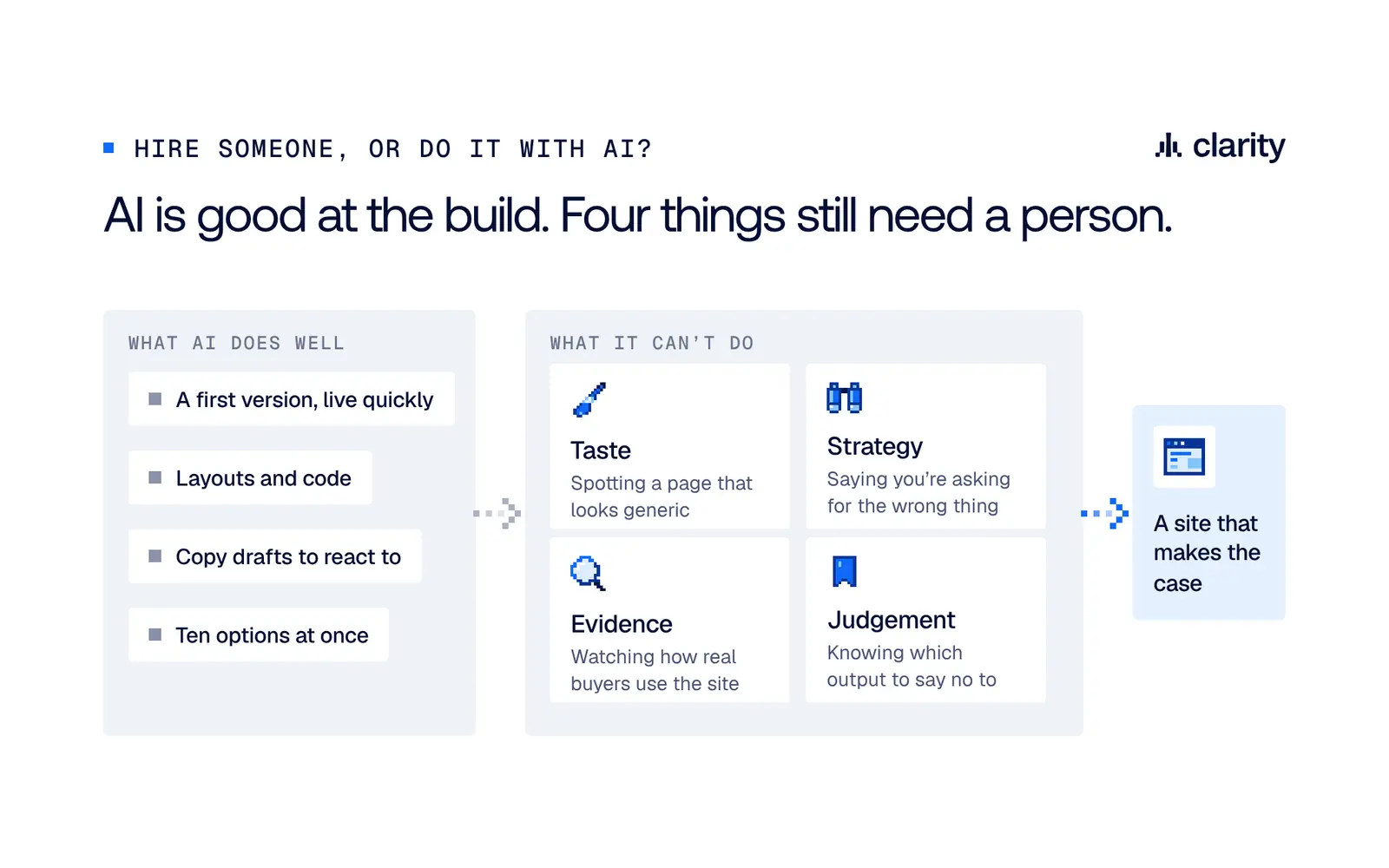
Taste
AI gives you the most likely answer. That’s why so many AI-built sites look the same. Knowing what good looks like, and spotting when something is generic, is still a human skill. Buyers notice when a site looks like everyone else’s, even if they can’t say why.
Strategy
AI will write whatever you ask for. It won’t tell you you’re asking for the wrong thing.
One founder we worked with ran a founder-led GTM firm. His clients had raised $750M+ from Tier-1 VCs, and he’d worked with over 20 YC startups. None of it was on his website. In his words: “That’s just not reflecting anywhere.” His goal was for the site to “catch up to the level of clientele that I’ve worked with”.
Ask an AI tool to redesign that homepage and you’ll get a cleaner version of the same page. The fix wasn’t a better layout. It was knowing that the proof belonged at the top, and that his clients wouldn’t let him publish their numbers, so named founder testimonials had to do that job instead. That’s a decision about his buyers, not about design.
Evidence
A good website is built on how real buyers behave, not on how you hope they behave. Heat maps and session recordings show where buyers stop scrolling, and what they were looking for when they left. AI can’t watch your buyers for you. Someone has to look, and know what they’re looking at.
Judgement
Good AI output takes a lot of feedback. AI will happily give you a hero that’s clever, a section that’s too long or a claim you can’t back up. Someone has to know which is which, and say no.
Why does one homepage prototype take 6–8 hours, even with AI?
When we redesign a B2B homepage, the order matters:
- Understand how the buyers decide: what they need to see, and in what order, before they’ll book a call.
- Look at how they use the current site, in heat maps and session recordings.
- Find where they stop scrolling, and what they were looking for when they left.
- Write the copy first, so the page answers the questions buyers actually have.
- Then design around it, with a lot of back and forth with AI along the way.
That takes us 6–8 hours for a single prototype. The hours aren’t spent generating. They’re spent deciding what’s right.
So it isn’t really AI or a designer. The strongest work right now comes from designers who combine taste and strategy with AI, and use it to try more and move faster. When a site isn’t well thought out, it’s rarely the tools. The thinking was skipped.
Using AI for content and design without clear brand rules? The same applies: someone has to make the brand before AI can follow it. Who should build your brand rules first.
What does a website built this way do?
When the thinking is done first, the site starts doing part of the selling. Here’s what that has looked like for a few of the B2B companies we’ve worked with:
“Within the first four hours of the website being public, I had a qualified lead book straight through it.” Alfie Lloyd, founder of Alaiso, a UK outbound agency for plan.com, Artificial and Jiga
“Within a couple of weeks of launch I was seeing more bookings from people who’d found me on ChatGPT and Gemini, and better-funded companies are now booking meetings where they were likely put off in the past.” Joel Sinclair-Horne, founder of Clay Playbook, a Certified Clay Solutions Partner
“In our first month live, one prospect self-identified as too small before we’d even spoken, another browsed our offers like a catalogue, and for the first time someone got on a call and told me ‘you have a cool website’.” Kellen Casebeer, founder of The Deal Lab, growth for 80+ GTM tech startups from seed to Series C
What should you look for if you hire externally?
Not every agency or freelancer will do that part well. Questions worth asking before you sign:
- Do they start with your buyers or with the design? Ask how they work out what the site should say. Copy should come before styling.
- Can they show you the work before you commit? A mockup, a redesigned homepage or an audit of your current site tells you more than a portfolio. It’s why we redesign your homepage for free before you pay anything.
- Do they look at how buyers use your current site? Heat maps and session recordings show where buyers stop scrolling and what they were looking for.
- Will you be able to edit it yourself afterwards? You should be able to change copy and add pages without them.
- Is it built to be found by search and AI tools? Plain text, clear headings and the facts buyers ask about, not hidden in images or tabs.
- How do they use AI? You want a clear answer, not “we don’t” and not “it does everything”.
- What happens after launch? Ask how they’ll check whether it’s working.
If they can’t answer these well, building it yourself with AI might genuinely be the better deal.
Is there a middle option?
You don’t have to choose between doing everything yourself and handing everything over.
Many B2B companies get the most from hiring for the strategy, messaging and design system, then keeping the day-to-day editing in-house. As one GTM agency founder put it:
“The site now shows how our work plays out instead of just describing it, and we can keep building on it ourselves.” Robert Bradley, founder of Korus GTM, AI-native GTM engineering for $50M–$500M B2B companies
How do the three options compare?
| Build it in-house with AI | The middle option | Hire someone externally | |
|---|---|---|---|
| The right call when | You’re early, deals are won on calls and referrals, and the website is rarely part of the decision | You want the strategy, messaging and design system done properly, and your team will keep the site up to date | You’re moving upmarket, your offer has changed, or buyers research you with AI before they get in touch |
| Who works out what the site says | You | An external team, then your team keeps it current | An external team, starting from your buyers |
| Watch out for | A site that looks fine but doesn’t make the case | Nobody owning the site after launch | Teams that start with the design, not your buyers |
Quick answers
- Can AI build a B2B website?
- Yes. AI can build the pages in an afternoon. It can’t yet work out, on its own, what your buyers need to see, and in what order, to trust you. That still takes someone who understands your business and your market.
- What does a web designer do that AI can’t?
- Decides what your buyers need to see and in what order, uses evidence from how they use your current site, and tells good from generic.
- Should a web designer use AI?
- Yes. A designer who uses AI well can try more and move faster. The value is in the feedback they give it, not in what it generates.
- Should I hire an agency or a freelancer?
- It matters less than how they work. Ask both how they decide what the site should say, whether they can show you work before you commit, and whether you’ll be able to edit the site yourself.
- Is it worth hiring a website agency for a small B2B company?
- If the website isn’t part of how you win deals yet, probably not. Once buyers are judging you by it, usually yes.
Naz Hashem is the founder of Clarity Design Studio (designwithclarity.co), a Melbourne-based brand and website studio for B2B companies. The studio has worked with 40+ B2B companies in Australia, the US, UK and Europe, including GTM agencies and Clay partners.
What’s your next move?
Starting costs nothing.
Waiting costs you bigger clients.
Fill in a short form about your company. We’ll review where your current site loses buyers and design your new homepage, free. If you like it, we build the rest. If not, you don’t pay a thing.
Don’t pay a single dollar unless you’re 100% satisfied
“It felt like I was partnering with an expert not only in web design and development, but with a product marketer with deep experience in my industry. Plus, in my opinion, the pricing is an absolute steal!”