For B2B founders, and the people who build their websites
Website design questionnaire: the questions about your buyers most templates skip

Websites7 min read
Summary
Most website design questionnaires ask about colours, pages and budget. A B2B website has to help a buyer decide. So the questions that matter are about the client’s buyers: who signs off, who else they compared, what nearly stopped them and why they chose you. Here’s the questionnaire we use on every project, and why each question is on it.
- Ask about the client’s buyers first. Colours and page lists can wait.
- Every answer should change something on the site: the headline, the order of sections or the proof.
- The best answers are already in closed-won sales calls, so read the transcripts as well as the form.
- Write the message and get it approved before anyone plans pages or designs.
A website design questionnaire should tell you how the client’s buyers decide, not just what the client wants the site to look like. Most templates ask about colours, page lists, logins and budget. Those matter later. A B2B website has one job first: help the right buyer decide you’re worth a call. So the questions that matter most are about those buyers.
Below is the questionnaire we use at Clarity Design Studio, after building websites for 40+ B2Bs. If you build sites for clients, send it after your first call. Copy it, then see why each question is on it.
Website design questionnaire template (copy and use)
Three groups. The first seven are the essentials: if a client only answers these, you can start.
The essentials
- What do you do, and who is it for?
- Look across all your closed-won deals, not just the favourites. What was going on for those clients when they came to you, who had to say yes on their side, and which ones do you want more of?
- What were they doing before you, and who else did they consider?
- Why did they choose you over the other options? And if you’ve lost a deal lately, who did it go to and why?
- What are your 2–3 strongest results or case studies?
- What do you sell, and which one do you most want to sell more of?
- What nearly stopped your closed-won clients from buying, and what do prospects worry about before saying yes?
Your website today
- What’s not working with your current website or brand, and how long has it been like that?
- What have you already tried to fix it, and how did it go?
- Roughly how many enquiries or calls booked come through your website each month, and how many visitors?
- What marketing are you running now, or planning in the next 6 months?
- What would a big win from this project look like?
If you have 10 more minutes
- What was the problem costing your clients before they fixed it?
- What changes for a client after working with you?
- What do people often believe before working with you that turns out to be wrong?
- How do people find you now, and what should a website visitor do next?
- Anything else that builds trust?
- Websites you like (and why), and anything you definitely don’t want.
A tip for clients: paste the questions into ChatGPT or Claude (ideally one you already use for work, so it knows your business), and ask for a first draft. Tell it to write “unknown” rather than guess. Then edit the draft in your own words. Your own words are what make the answers useful.
Sample questions, and why each one matters
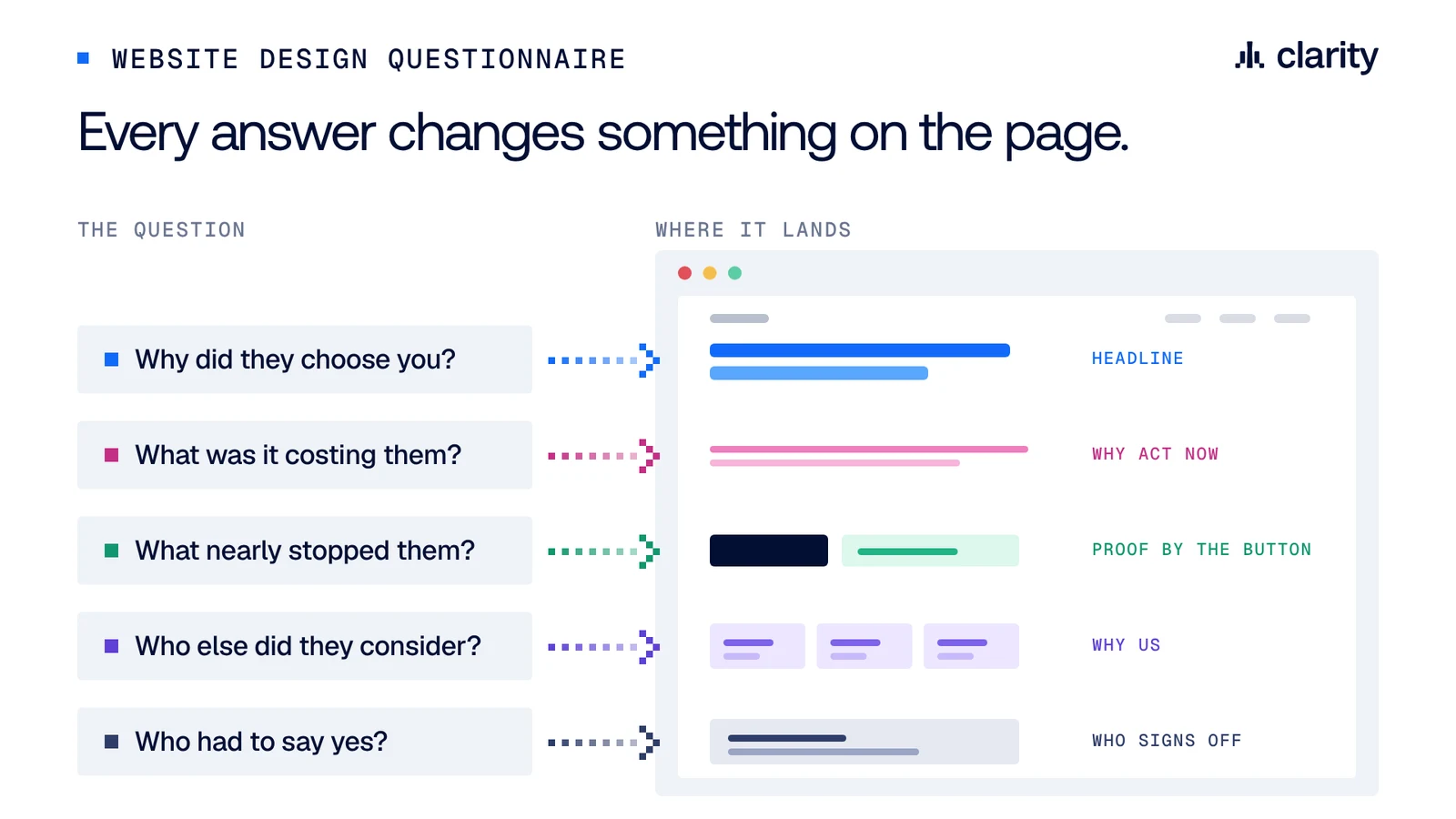
Every question should change something on the site. If an answer wouldn’t change anything, the question doesn’t belong.
| Question | What it tells you | What it changes on the site |
|---|---|---|
| Who had to say yes on their side? | Who signs off, and whether they ever talk to you | Pages that make the case for the person who isn’t on the call |
| Who else did they consider? | What you’re really compared with: a rival, doing it in-house, or nothing | Why you, said plainly against those options |
| Why did they choose you? | The real reason buyers pick you, in their words | The headline, and the first thing below it |
| What nearly stopped them? | The doubts that stall a deal | Proof and answers placed where each doubt comes up |
| Why did you lose a deal? | What the site failed to answer | What to add or fix first |
| What was the problem costing them? | What’s at stake for the buyer | Why act now, without inventing urgency |
How do B2B buyers make decisions?
Our clients tell us their buyers judge them on the website, often before the first call. Here’s what they’ve seen.
They check you out after hearing about you. An email, an adviser’s intro or an event sends them to your site. A private investment firm told us when sellers look at its site: “after receiving an email from us… or if we’ve been introduced to them via an advisor”. The site’s first job is to confirm you’re the firm they heard about. (If yours makes you look smaller than you are, here’s what to change.)
The person who decides may only see the site. The person you speak to often isn’t the one who signs. One founder found that directors at larger firms judged the business in 30 seconds to a minute, and the site didn’t pass. Every page has to make the case without you there.
They rule themselves out on small details. The same investment firm chose to take most of its deal criteria off its site, because sellers might read one line and leave: “…I’m selling 51%, these guys are the 49, see you later.” Anything that might turn away a good-fit buyer belongs in a conversation, not on the homepage.
Their reason for choosing you may not be what you lead with. The same founder’s firm, an IT provider, posted mostly about AI. Its bigger customers chose it for knowing their industry as well as they did. That’s why we look for the reason in sales call transcripts, not in the marketing.
Each doubt needs its own answer. A software company selling to regulated manufacturers listed what its buyers worry about before saying yes:
- the price, against the licence they already own
- whether it will be accurate on their hardest files
- moving their old work across
- what happens to their data during a trial
- whether their IT team will approve a cloud tool
A better headline answers none of these. Each needs a fact, placed where the doubt comes up.
How do you build a website that speaks to your buyers?
Work out how they decide before you design anything. At the start of every project, we run the same six steps.
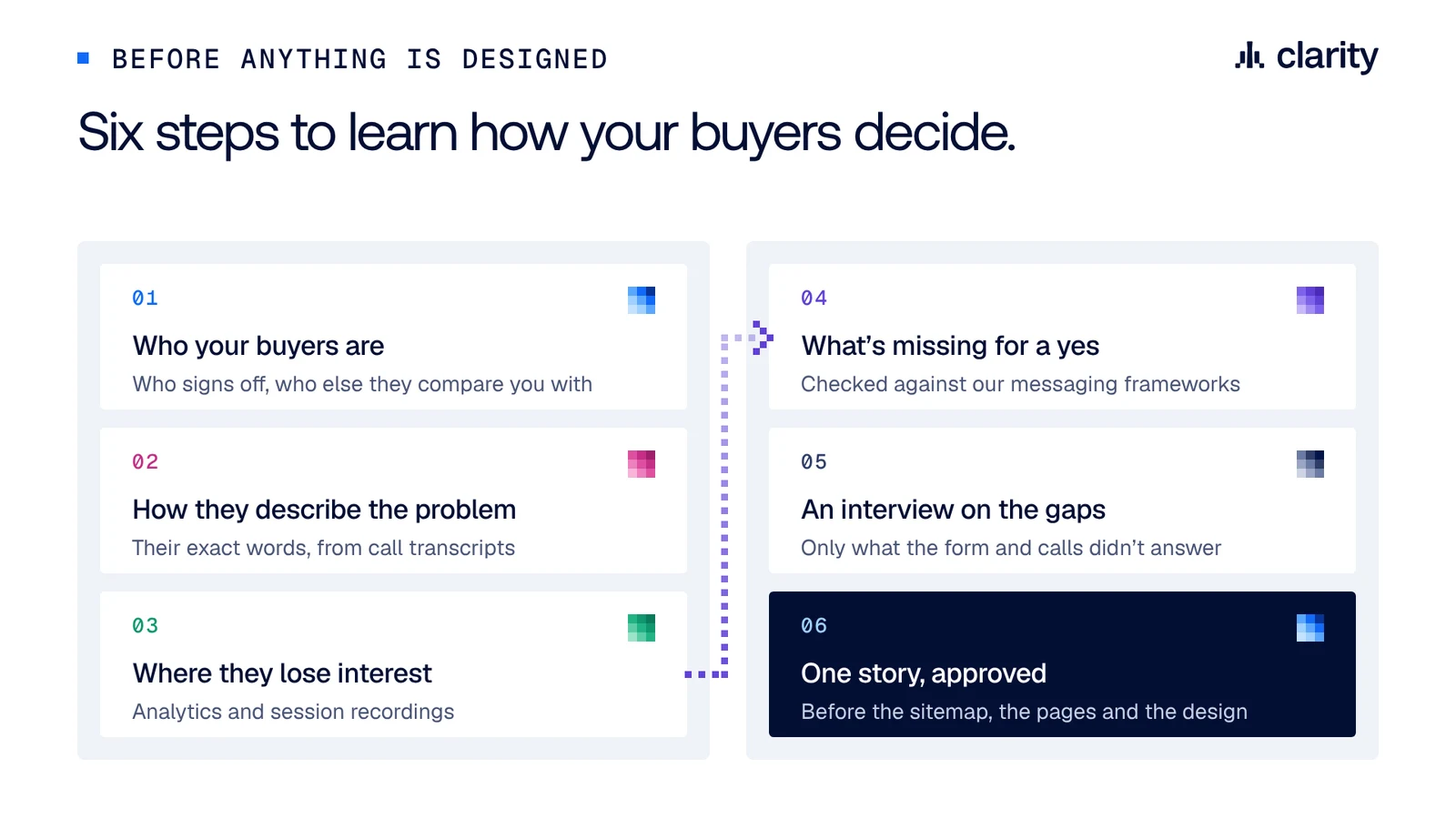
- Who the buyers are, and what they’re deciding between. The questionnaire above: who signs off, who else they compare you with and what’s at stake for them.
- How buyers describe the problem. We go through the transcripts of every call so far and pull the exact words used. Buyers trust a site that sounds like the conversation already in their head.
- Where buyers lose interest on the current site. Analytics and session recordings, when we have access: which pages they read, where they stop scrolling and what they never click.
- What’s missing for buyers to say yes. We check everything against our messaging frameworks. Is it clear who the buyer is? Is the problem theirs? Is there proof they’ll believe, and a reason to act now?
- An interview built around the gaps. Only the questions the form and calls haven’t answered, so every answer comes from the business, not from us.
- One story, approved before the sitemap. A messaging document sets what each buyer needs to hear, and in what order. Only then do we plan the pages and design them.
It’s the slowest part of a project. It’s also why, by the time anything is designed, every section answers a question a real buyer is asking. (If your offer has changed since the site was built, start with the story, not the design.)
What should you prepare before a website redesign?
If you’re about to brief a designer or agency, gather these first. They make the questionnaire quick, and the site better.
- Your closed-won deals, all of them, and what was going on for those clients when they came to you.
- Who else they considered, including doing it in-house or doing nothing.
- Recordings or transcripts of closed-won sales calls, as many as you have. They hold your buyers’ real words.
- Your strongest results, with numbers where you can share them.
- The doubts you hear before people say yes, and why you’ve lost deals.
- Access to your analytics, or a screenshot of the last few months.
Then the people building your site can spend their time on the website and the positioning, not on guessing. Or, to see what this research does to your own homepage first, start with a free homepage redesign.
Quick answers
- What are good questions to ask a client before designing a website?
- Start with their buyers: what was going on for their closed-won clients, who else those clients considered, why they chose them and what nearly stopped them. Then ask about the current site, their goals and the marketing that will send people to it.
- What do you need to know before building a website?
- Who the site is for, what those buyers are deciding, what makes them doubt, and what should happen when they’re ready. Pages, features and style come after that.
- How long should a website design questionnaire take to fill in?
- Ours has seven essential questions that take about 10 minutes. The rest are optional, and anything we already know from a call is filled in for the client to check.
- Should the client fill in the questionnaire before or after the first call?
- After. We send it once we’ve spoken, with what they told us already filled in, so they only add what we couldn’t know.
Naz Hashem is the founder of Clarity Design Studio (designwithclarity.co), a Melbourne-based brand and website studio for B2B companies. The studio has worked with 40+ B2B companies in Australia, the US, UK and Europe, including GTM agencies and Clay partners.
What’s your next move?
Starting costs nothing.
Waiting costs you bigger clients.
Fill in a short form about your company. We’ll review where your current site loses buyers and design your new homepage, free. If you like it, we build the rest. If not, you don’t pay a thing.
Don’t pay a single dollar unless you’re 100% satisfied
“It felt like I was partnering with an expert not only in web design and development, but with a product marketer with deep experience in my industry. Plus, in my opinion, the pricing is an absolute steal!”