For B2B founders
We’ve changed what we sell, but our website still describes the old business. What should we do?

Websites4 min read
Summary
Start with the story, not the design. Write down what you sell now, who it’s for and why they should pick you, in the words your buyers use on calls, then rebuild the pages around that. A new design on the old story just makes the old business look newer.
- If buyers describe you differently on calls from how your homepage does, the site is out of date, however new it looks.
- Decide the new story before anyone opens a design tool.
- Most firms need new words and a new page structure. Some need a new brand as well.
- Show proof of the new work, so the change reads as real and not a rebrand for its own sake.
It happens to most growing B2B companies. You add a service, move into a new market or change how you deliver the work, and the business moves on faster than the website does.
For a while it doesn’t matter, because most of your deals come from people who already know you. Then you start selling to people who don’t, and the website is the first thing they check.
One GTM agency founder we worked with put it plainly:
“We’d pivoted into a 12-month GTM transformation, but our site was still one page about cold outbound.” Robert Bradley, founder of Korus GTM
How do you know your website still sells the old business?
A few signs, in rough order of how often we hear them:
- Buyers describe you differently from your homepage. If the way prospects explain what you do on calls doesn’t match the first lines of your site, the site is behind.
- You explain on calls what the site should already say. Your first ten minutes go on correcting the impression the website gave.
- The new service is a line in a list. It’s the work you most want to sell, and it sits as one bullet among the old ones.
- The homepage has become a directory. The marketing lead at a logistics and supply-chain company of several hundred people described theirs as “the home page kinda serves more as, a directory”.
- AI tools describe the old business. Ask ChatGPT or Gemini what your company does. They describe you from what your site and other sites say, so if the answer is out of date, your site probably is too.
Why doesn’t a redesign on its own fix it?
Because the problem isn’t how the site looks. It’s what the site says.
A new design on the old story makes the old business look newer. Buyers still can’t tell what you’re best at now, or whether the new work is for them. And it’s the story that takes the time: deciding what you lead with, what you drop, and how you explain the new offer to someone who’s never heard of you.
What should you do first?
Work through it in this order:
- Write the new story before anything else. What you sell now, who it’s for, what changes for them, and why they should pick you. Use the words your buyers use on calls, not the words in your old deck. That’s what positioning work is: customer interviews, a look at competitors, then the messaging and copy.
- Decide how big the change is. New words, a new structure, or a new brand as well (the table below).
- Give each offer its own page. If the new work matters, it needs a page that explains it, with its own proof and its own next step, rather than a paragraph on the homepage.
- Show proof of the new work. A result, a client quote or a short example. Without it, the change reads as a rebrand for its own sake.
- Make it plain in text. Key facts, the offer and who it’s for in the page copy, not only in images or video, so search engines and AI tools pick up the change too.
It’s especially common with GTM and outbound agencies that have moved from cold email to GTM engineering or a full transformation offer.
How big a change do you need?
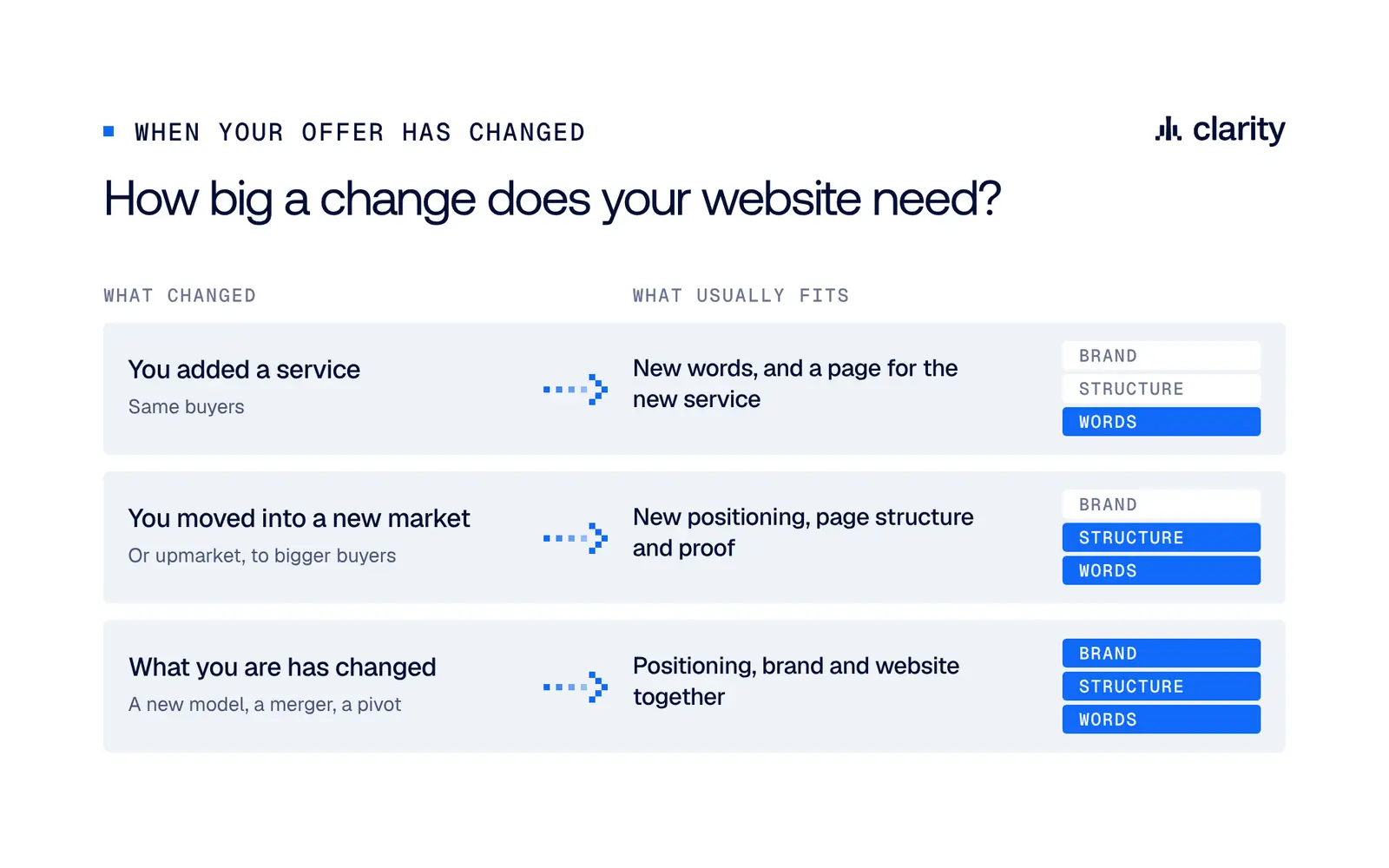
| What changed | What usually fits | Watch out for |
|---|---|---|
| You added a service, same buyers | New words on the homepage and a page for the new service | The new service buried as one bullet among the old ones |
| You moved into a new market or upmarket | New positioning, a new page structure and proof for the new buyer | Proof that only speaks to the old market |
| What you are has changed (a new model, a merger, a pivot) | Positioning, brand and website together | Reusing the old site’s structure because it’s quicker |
What does it look like when it’s done?
For Korus GTM, the change was moving from a one-page site about cold outbound to a site that explains the transformation work:
“The site now shows how our work plays out instead of just describing it, and we can keep building on it ourselves.” Robert Bradley, founder of Korus GTM
LeanScale, a RevOps agency, refreshed its website when its offer changed: it had become an agentic agency, with AI agents built for specific jobs. In the 3 months after launch, visitors were up 70% and pipeline was up from $60k to $100k.
“A better look, performance and content than anything we’ve had before.” Jake Toepel, CTO, LeanScale
If you’re not sure how far your site has fallen behind, the quickest test is to see your homepage rewritten around what you sell now, then compare the two.
Quick answers
- Can we just update the copy instead of redesigning the whole site?
- Sometimes. If the pages still fit how you sell, new words can be enough. If the new offer needs its own pages, or the homepage has turned into a list of everything you do, new words on the old layout won’t fix it. Starting with the homepage is a good way to find out.
- Do we need a rebrand as well as a new website?
- Only if the brand still looks like the business you were. If the look is fine and it’s the message that’s wrong, start with positioning and the site, and keep the brand.
- Our agency has moved into AI. How should the website show it?
- Lead with what clients get now, show how the work runs step by step, and put proof of the new work next to it. Say it in plain text on the page, because AI tools describe you from what your site states.
- How long does it take to reposition and rebuild a website?
- Most websites take about 6 weeks from kick-off to launch, and brand work adds 2–4 weeks before that. The biggest factor is how quickly you can review and sign off each stage.
Naz Hashem is the founder of Clarity Design Studio (designwithclarity.co), a Melbourne-based brand and website studio for B2B companies. The studio has worked with 40+ B2B companies in Australia, the US, UK and Europe, including GTM agencies and Clay partners.
What’s your next move?
Starting costs nothing.
Waiting costs you bigger clients.
Fill in a short form about your company. We’ll review where your current site loses buyers and design your new homepage, free. If you like it, we build the rest. If not, you don’t pay a thing.
Don’t pay a single dollar unless you’re 100% satisfied
“It felt like I was partnering with an expert not only in web design and development, but with a product marketer with deep experience in my industry. Plus, in my opinion, the pricing is an absolute steal!”